Thursday, October 11, 2012

1968: Richard Nixon

Sam Phillips
Poli Sci
10/11/2012


After President Lyndon Baines Johnson decided against seeking the Democratic Party's nomination for president in 1968, his Vice President, Hubert Humphrey, received the Party's nomination after a contentious primary centered on the Vietnam War that culminated in large protests at the Democratic National Convention in Chicago. Vice President Humphrey would face Republican former Vice President Richard Nixon, who had lost the 1960 Presidential election to John F. Kennedy, as well as Alabama Governor George Wallace, running on the American Independent ticket. Though the third party, segregationist, Wallace did gain some foothold around the country, his vice presidential pick of Curtis Lemay, an atomic bomb friendly air force official left many worried about his foreign policy qualifications, and therefore he did not garner enough votes to make significant inroads outside the deep south. Hubert Humphrey ended up close to Nixon in the popular vote, he was unable to shake his connections to Johnson's administration. Nixon ended up winning the electoral college 301 to Humphrey's 191 to Wallace's 45, winning the popular vote 43.4% to Humphrey's 42.7% to Wallace's 13.5%. 


Though he lived two millennia ago, the campaign tactics of Cicero are still widely studied and discussed as the tenets of successful campaigning today. Though Cicero wrote of many strategies to gain popularity, one in particular stands out as a particularly meaningful tip in the election of 1968-to come across as a traditionalist and connect with people. In an election dominated by foreign policy and strategies for Vietnam, the largest issue on the homefront was that of the proliferation of protests by college students, African Americans, women, and other groups fighting for civil rights, gender equality, and an end to the war in Vietnam. The chief goal of the various candidates was to come across as a law and order candidate that stood up for ordinary Americans that were not protesting. Nixon named these average people in his nomination speech, "It is another voice, it is a quiet voice in the tumult of the shouting. It is the voice of the great majority of Americans, the forgotten Americans, the non shouters, the non demonstrators. They’re not racists or sick; they’re not guilty of the crime that plagues the land; they are black, they are white; they’re native born and foreign born; they’re young and they’re old." George Wallace ran as an even tougher law and order candidate and was known for his frequent tirades against hippies and his reverence for the working class. Democrat Hubert Humphrey also tried to shake his party's image as the party of protesters and students in a campaign ad entitled "Law and Order Democrat." All three candidates followed Cicero's advice in putting on the face of a traditionalist; however, Humphrey could not do this convincingly enough, and Wallace's support was too regional to prevent Nixon from winning the election. 

Richard Nixon was not considered a great campaigner due to his image, as was on display in his run against John F. Kennedy, and it was largely circumstances that allowed Nixon to be elected. Hubert Humphrey was an extremely weak candidate, even inside his own party. It took all the political clout of Lyndon Johnson to get Humphrey nominated over Eugene McCarthy, the more popular choice. Therefore, expectations were low for Humphrey due to the relatively little enthusiasm amongst his own party. On the other hand, George Wallace fired up crowds with his blunt nature, but had a message tailored for the deep south. Even he knew that he was unlikely to win, instead he wished to force an election in the House of Representatives and therefore have some power in the process. However, Humphrey was too weak a candidate to prevent a Nixon majority, therefore Wallace could not be a player. Nixon was clearly the favorite in the 1968 election, and his campaign strategy of being a man of ordinary Americans (whom he would term "The Silent Majority" in his inauguration address) reflected this. He did not need have the theatrics of John F. Kennedy's jingles, rather he needed to ensure that he remain ahead. Therefore, he was quite careful and safe in his strategy.

One such strategy Nixon had for the maintenance of his lead was to attack Democrats for being a party divided that would bring about a divided America. In his campaign ad "Failure" Nixon rips Democrats for not keeping order at their convention and for being divided as a party.


 The 1968 campaign was particularly negative due to the nature of the law and order issues being stressed by candidates. In his nomination speech Nixon does not explicitly attack Democrats, but he makes it clear that the alternative to his defense of average Americans is the New Left radicalism of college students. Nixon attempted to smear Democrats as being the party of students, and paint students as the antithesis to American values. Thus, these campaign issues allowed for attacks to become more harsh, as not only policies, but values were at stake. This type of values based policy attack is once again apparent in the modern day as social issues become increasingly important to voters of various demographics.


Bibliography

The American Presidency Project. Accessed October 10, 2012. 
     http://www.presidency.ucsb.edu/showelection.php?year=1968. 

1968 Nixon V. Humphrey. Accessed October 10, 2012. http://www.kennesaw.edu/pols/ 
     3380/pres/1968.html. 

Democratic Party. "Law and Order Democrat." The Living Room Candidate. Video file, 1:01. 
     Accessed October 10, 2012. http://www.livingroomcandidate.org/commercials/ 
     1968. 

Nixon, Richard Milhous. "Acceptance of Nomination." Speech, Republican National 
     Convention, Miami, FL, August 8, 1968. 

PBS. "1968 Campaign." PBS. Accessed October 10, 2012. http://www.pbs.org/wgbh/ 
     amex/wallace/peopleevents/pande07.html. 

Republican Party. "Failure." The Living Room Candidate. Video file, 1:01. 
     Accessed October 10, 2012. http://www.livingroomcandidate.org/commercials/ 
     1968. 
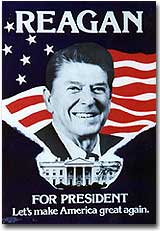
Ronald Reagan. 1980


Ronald Reagan won the 1980 election because he expressed confidence, poise, and brought hope and direction to a nation desperately in need of it. Carter lost because of the turmoil he faced during his first term as president and his lack of assurance in his ability to handle it or bring change and because he attacked Reagan too vehemently.
            Ronald Reagan promised change and instilled confidence in the American people and this largely secured him the 1980 election. Reagan’s campaign sought and promised to fix all of the many issues facing the nation in the late 1970s such as stagflation and increased tensions abroad and he suggested fixes that were vague, contradictory, and impractical in reality. These plans included cutting government spending while simultaneously increasing military expenditures, increasing the size of the military with the goal of world peace, or claiming that decreased spending would bring back prosperity with no explanation of why. These plans were all united in one aspect however, they offered a sense of hope to the nation and suggested that Reagan had a plan to return prosperity and stability to a nation in dire need. This strategy was directly adopted from the advice of Cicero to “bring hope to people and a feeling of goodwill toward you” and do to so through “vague generalities”. Reagan came to be known as the “great deflector” as he skillfully avoided answering difficult questions and describing details of his plans that were difficult or unclear and although this appears negative in doing so he avoided exposing many negatives and put on the façade that he had answers and methods to fix the nation. Reagan also utilized the campaign strategy of obtaining celebrity endorsements when he had Reverend Jerry Falwell support him and try to create the “moral majority”. The reverend tried to appeal to citizens who viewed Reagan as more moral and searched for a greater sense of religious morality in backlash to the turbulence of the 1960s and 70s. This sense of direction and poise that Reagan and his campaign embodied excited the American people and got them excited about the possibility of success and stability that the nation lacked under Carter in his first term.
            Incumbent candidate Jimmy Carter lost the election of 1980 because of his weak first term and his inability to express confidence or suggest that great change would occur in his second. Carter lacked strength in his campaigning when he refused to debate Reagan and made several speaking errors that suggested a lack of control and direction over the nation. His refusal to debate Reagan made him appear weak and fearful and caused Reagan to claim that Carter was desperately trying to stay in office and didn’t have any real ideas or incentives for the nation. Carter countered criticism when he suggested that the whole nation was suffering from a lack of confidence, which came off as a deflection of responsibility from the government and from himself. He also made mistakes with good intentions for example when he attempted to relate himself to voters by discussing enlisting the help of his daughter on a nuclear arms issue he appeared to be unable to handle the issue himself or seek suitable counsel. Carter’s previous term, whether his fault or not, was one in which the American economy was in shambles and foreign enemies attacked from every corner and Carters platform suggested little change and promised little revitalization which resulted in only 9% of voters claiming that they felt personally interested and excited about him. Carter also seemed weak and incompetent when he tried to run a smear campaign against Reagan but instead came off as too harsh and mean hearted. This anger towards Reagan became apparent when the two did debate and Carter appeared as if he was going to “slug” his competitor. This inability to maintain a persona of composure and power lost Carter many voters. Altogether a range of factors such as his lack of composure and misspeaking contributed to his losing of the election but most fundamentally he fell short because he offered little change from his previous and largely unsuccessful term and did not excite the people with innovation.
            This election highlights a fundamental truth in most elections, which is that the people want the appearance of power and the promise of prosperity, they do not want the truth and they do not want to have to take the responsibility. When Carter suggested that the problems of the nation stemmed from the mindsets of the voters he isolated himself from the people as they expected a leader who would take responsibility and initiative in fixing the problems of the nation. This is exactly what Reagan offered, whether concretely backed up or not, he promised change and a return to the excellence and morality that many citizens felt had been lost in the tumultuous recent times.

*This photo shows the confidence Reagan embodied and the hope he instilled in citizens to return to the powerful and stable America they had once known.


Bibliography

"Republican Party Platform." Address, Republican National Convention, Detroit,
     Michigan, July 15, 1980.
     
      "Democratic Party Platform." Address, Democratic National Convention, New                            York, New York, August 11, 1980.

Shogan, Colleen, Dr. Presidential Campaigns and the Congressional Agenda:
     Reagan, Clinton, and Beyond. Report. Washington DC: George Mason
     University.

The University of Virginia Miller Center. "Ronald Wilson Reagan: Campaigns                    and Elections." American President: A Reference Resource.                                     http://millercenter.org/president/reagan/essays/biography/3.


Wednesday, October 10, 2012

1904: Theodore Roosevelt

Graham Steele
Poli Sci
10/10/12

After President William McKinley's assassination in 1901, Theodore Roosevelt became president.  Roosevelt had only grudgingly accepted the vice presidency nomination in 1900, yet he became an extremely popular president.  Though he was a member of the Republican Party, some of Roosevelt's policies included Democratic ideas, which broadened his base of voters by appealing to both parties.  Some of this policies were unpopular with Republicans; however, they quickly and decisively nominated him for election at the 1904 Republican Convention.  His slightly controversial platform of trust-busting, tariffs, labor relations, and interventionism was also adopted.  The decisiveness of the Republicans greatly contrasted with the Democratic Convention, in which several nominees were proposed and where many Democrats were divided on the issues of free silver and anti-expansionism.  In the end, Alton B. Parker was nominated, but the party remained separated.  This weakened the Democrats and, in conjunction with Roosevelt's wide-spread popularity, led to a landslide victory for the Republicans.  Roosevelt won 7,628,785 or 57.4 percent of the popular vote, while Parker only got 5,084,442 or 37.6 percent of the votes.  As seen in this electoral map of the United States in 1904, Roosevelt got 336 of the electoral votes, while Parker managed to win just 140.


Roosevelt was popular with voters around the country because of his experience as President, his military service, and his range of political policies.  He also, used campaign pins that portrayed him as patriotic and a war hero to improve his candidate image.  These pins often featured him superimposed upon the American flag or in military dress.  This connects with a campaigning technique that remains popular today, creating a positive candidate image.  The Roosevelt pins portrayed him in a flattering light and also increased voter awareness and recognition by continually showing his face.  Campaigning was viewed as unofficial and narcissistic during this time period, so neither Roosevelt, nor Parker actively worked to persuade voters.  This actually further helped Roosevelt because while he had proven experience as president, Parker was less known and popular and without campaigning, he was unable to show his attributes and win over voters.  Roosevelt's positive candidate image, popularity, and the lack of campaigning contributed to his overwhelming victory.

Two of the important campaigning suggestions Quintus Cicero offers his brother are capitalizing on weak opponents and appealing to a wide variety of voters.  The major weakness of Parker's campaign was that the Democrats were divided on several issues.  One of the issues that many Democrats disagreed on was the silver or gold currency question.  Since many undecided and persuadable voters disagreed with Parker's policy concerning this issue, they decided not to vote for him.  Roosevelt then acquired their votes by appealing to both Republicans and Democrats by proposing a wide range of policies.  Some of his ideas favored Republicans and others supported Democratic interests, making him moderately popular with both parties, while Parker was unpopular with almost everyone.  By following Cicero's campaign tips, Teddy Roosevelt officially dispelled the remarks that he was a "political accident."


Bibliography:

American Government, s.v. "election of 1904," accessed October 9, 2012. http://americangovernment.abc-clio.com/Search/Display/200978?terms=1904+election.

American Government, s.v. "Election of 1904," Map, accessed October 9, 2012. 
http://americangovernment.abc-clio.com/Search/Display/212825?terms=1904+election.

American Government, s.v. "Alton B. Parker," accessed October 10, 2012. 
http://americangovernment.abc-clio.com/Search/Display/219414?terms=alton+b+parker.

American Government, s.v. "Democratic Party Platform (1904)," accessed October 10, 2012. http://americangovernment.abc-clio.com/Search/Display/210039?terms=1904+platform.

American Government, s.v. "Republican Party Platform (1904)," accessed October 10, 2012.  
http://americangovernment.abc-clio.com/Search/Display/210040?terms=1904 +platform.


Boller, Paul F., Jr. Presidential Campaigns. New York City, NY: Oxford University Press, 2004.

Cicero, Quintus Tullius. "Campaign Tips From Cicero." foreign affairs 91, no. 3 (2012): 19-28.

Grant Kaplan
Ms. Shapero
Green Class
Political Science
10/10/12
Ulysses S. Grant and the 1868 Election
 
After leading the Union Army to victory against the Confederates in the Civil War and preserving the unity of the nation in the process, Ulysses S. Grant was viewed by a majority of Americans as a perfect candidate for president. With former President Andrew Johnson unwilling to punish the Southern states for their disloyalty, American citizens were ecstatic to have the fierce General of the Union Army as an option for president, convinced he would make the right choices in dealing with the returning states. Although Ulysses S. Grant’s presidency was labeled by many as a failed term, Grant’s positive public image and wealth of celebrity endorsements helped secure him the position of 18th president of the United States of America.
One major group of Americans that Grant appealed to was African Americans, both those that were freed by the war and those that were free before. During the Civil War, Grant’s admiration for African Americans grew as he recognized their reasoning for fighting in the Union Army, “Black soldiers played an increasingly important role in Union victories after 1863. Slaves, in effect, became soldiers and freed not only themselves but all of their people. Grant felt a special obligation to these men who were truly fighting for their own liberation.” Because of his appreciation and recognition of the role of African American soldiers in the Civil War, African American citizens believed Grant would work for new civil rights laws and acts. Grant was not immediately supportive of equal rights, however: “when the war ended Grant had been against enfranchising the freedmen. They would have to be educated first, he argued, before they could vote. The violent reaction to Reconstruction, epitomized by the attacks on peaceful demonstrations to promote black rights, changed his mind.” During Grant’s campaign flocks of African Americans moved to Washington D.C. to be closer to Grant, “Black people were moving into the city [Washington D.C.] in large numbers; they were even moving right next door. They were pressing for places in the city government and on the school board… they were all looking to …Ulysses to do for them what Andrew Johnson had so disappointingly chosen not to do.” Grant’s campaign inspired the new freedmen to search for new jobs and opportunities, with realistic hope in Grant’s protection from racial terror. Ulysses S. Grant’s support from African Americans helped him secure the presidency because of his determination to provide them with equal rights.
Although extremely popular and respected, Ulysses S. Grant was not very enthusiastic about his presidential campaign, and only accepted the republican nomination because he felt it was necessary to protect the nation. John Y. Simon, known for his work editing President Grant’s papers and documents, wrote that “the documentary record sustains the view that Grant did not seek the nomination, did nothing to enhance his candidacy, and accepted the nomination as an obligation.” Simon’s description of Grant’s activity in his campaign is important because Simon is a Civil War scholar and studied Grant in great detail while editing his papers. Afraid of losing all of the progress he had fought for, Grant felt “forced” to run, writing that “I could not back down without, as it seems to me, leaving the contest for power for the next four years between mere trading politicians, the elevation of whom, no matter which party won, would lose to us, largely, the results of the costly war which we have gone through.” One characteristic often used to describe Grant was quiet. George Templeton Strong, a famous diarist during the Civil War, wrote that “Grant’s chance for the White House is worth tenfold than of any other man. This is partly due to the general faith in his honesty and capacity, and partly to his genius for silence.” Grant’s silence helped bolster his image as a wise and thoughtful leader, contemplating action instead of following his emotions blindly. Many citizens “saw in him a settle quality…called the habit of mute persistence.” Mark Twain was particularly impressed by his quiet manner, writing years later that “that countenance of his never betrayed him.” Grant was a sturdy presence that Americans looked up to, keeping America together with Abraham Lincoln. Interestingly, Geoffrey Perret, a famous American historian, wrote that “the excitement he [Grant] generated, even though he usually said nothing, or nothing much, was a beacon of the political movement… the true successor to Lincoln wasn’t the Tennessee Tailor but Grant. The hero who had won the war was the only man of the people – not the politicians – trusted to win the peace.” Perret believed that Grant’s influence could unite the people and restore order to the nation during Reconstruction, comparing him to another respected president, President Lincoln. Similarly, Grant received a major endorsement in an article from the Boston Post, which wrote “Though the war in which he [Grant] has won his renown is now…ended, the future has still much to do in establishing the position which Grant holds in history. To-day he enjoys the confidence of his countrymen to a degree unknown to military leaders during the war… If ultimately successful in the end…he… will find little difficulty, in tracing out a comparison between his character and that of the country’s first great leader.” This comparison to George Washington inspired many Americans, mostly in the northeast, to view Grant as the powerful, courageous leader that would return America to the hopeful, lively, united state it was in following the Revolutionary War.  One of my favorite Grant quotes came after the 1868 election, when he tells his wife, Julia Grant, of his victory, “I am afraid I am elected.” This quotation is a perfect example of Grant’s lack of enthusiasm about his election, but also his recognition of the importance of his position: he felt he must restore order to prevent Southern chaos and ensure unity.
Ulysses S. Grant’s greatest campaign technique utilized in the 1868 election was celebrity endorsements. Similar to Quintus Tullius Cicero’s advice to his brother Marcus about endorsements some 2000 years ago, where he writes that “one thing that can greatly help…is the backing of the nobility… you must diligently cultivate relationships with these men of privilege,” Grant was able to gain supporters through major endorsements by major political figures, who were seen as celebrities during the 1800’s. One of the most influential endorsements gained by Grant came from Richard Taylor, a former Confederate General and son of President Zachary Taylor, “President Grant was assured by all about him that he was the delight of the Radicals, greatest captain of the age, and savior of the nation’s life.” Taylor’s assessment of Grant is important because it illustrates the strength of Grant’s image to not only Northerners he had fought for, but also Southerners that he had fought against. Grant’s image as a war hero earned him the support of most Americans and added respect. Augustus Garland, a senator in both the U.S. and the Confederate States as well as the 11th governor of Arkansas and the Attorney General of the U.S. under Grover Cleveland, believed that Grant could “rescue us from destruction, and lay broad, deep, and permanent, the foundation for our own well being.” Garland’s endorsement is significant because his long history in the political world led to a large group of supporters following Grant, giving him additional votes and political allies. Another endorsement came from Ohio Congressman John A. Bingham, known as a framer for the Fourteenth Amendment and as a prosecutor in the impeachment trials of Andrew Johnson, who said that Grant “had never rested nor wearied in his pledge to secure to every citizen of the Republic, white and black, the full enjoyment of the rights guaranteed to him by the late amendments to the Constitution.” Bingham’s endorsement was important because of his popularity through his role in the impeachment of Andrew Johnson, who was strongly disliked by most citizens because of his unwillingness to punish Southerners following the Civil War, and his unwillingness to provide equal rights to the freedmen. Not all endorsements came from well known politicians, however. In fact, one of the most famous quotes from Grant supporters came from a former cavalry man after one of Grant’s speeches in Central Park, “He is the Country’s best hope in Peace, as he has been in War!” This saying became popular, especially with former soldiers, and was important because it illustrated the strong, positive feelings American citizens felt toward Grant. Overall, endorsements proved to be Grant’s strongest campaign strategy, especially because he didn’t put almost any effort into travelling around or campaigning for himself.
While Grant benefitted greatly from endorsements, the thing that made his most attractive to the American Citizens was his personality. Grant’s quiet, contemplative nature connected him to the people. Grant’s image as a war hero reassured the citizens of his leadership skills and heightened their respect, but his everyman personality made him appear as normal and likeable. Americans needed someone they could trust to lead them through Reconstruction, not just any politician, and they knew it: “A majority of American voters in 1868 wanted someone above politics who would restore order. Grant was that man.” Even though Grant was extremely popular with the public, he only narrowly beat Democrat Horatio Seymour, with 52.7 percent of the vote. Seymour campaigned more for himself, which helped him against Grant, but was not enough to fight Grant’s public image, getting only 47.3 percent of the vote.
 
Ulysses S. Grant and Schuyler Colfax on a campaign poster. Showing the emphasis on Grant’s war hero image by labeling him as “Gen.” and using his initials coincidentally to connect him to the U.S.
 
Ulysses S. Grant and Schuyler Colfax on their campaign poster.
 
Ulysses S. Grant over the Republic Platform.
 
 
Bibliography
The Atlanta Constitution. “South Carolina.” December 14, 1871
The Atlanta Constitution. “South Under Radical Rule.” July 26, 1870.
Bunting, Josiah, III. Ulysses S. Grant. New York, NY: Times Books, 2004.
McFeely, William S. Grant: A Biography. New York: W. W. Norton & Company, 1981.
Perret, Geoffrey. Ulysses S. Grant: Soldier and President. New York: Random House, 1997.
Waugh, Joan. U.S. Grant: American Hero, American Myth. Chapel Hill, NC: University of North Carolina Press, 2009.
Whitson, James R. “1868.” President Elect. Accessed October 8, 2012. http://presidentelect.org/.html.

Obama's 2008 Campaign - Alison LePard


President Barack Obama was elected on November 8, 2008, making history by becoming the first African American President of the United States. Obama was successful in using traditional techniques and strategies to win the election, such as grass roots campaigning, innovative technology, and celebrity endorsements. His campaign also incorporated some of the ideas from Cicero, a general and politician from Ancient Rome, proving that despite the seemingly drastic time difference, these political principles and approaches remain effective.
            Quintus Tullius Cicero lived from 103-43 BC, however today we still study his essay, Campaign Tips From Cicero: The Art of Politics, From the Tiber to the Potomac, a letter written to his brother Marcus Tullius Cicero, who planned to run for office.   One of the techniques Cicero advocates is the idea of being a chameleon or slightly adjusting one’s behavior and views to the crowd a candidate is addressing and giving that particular group of people a feeling of hope. In addition, Cicero advises candidates not to leave “Rome,” meaning they cannot take a vacation while campaigning, they must remain focused on the campaign and the issues. This continuous connection with voters reminds them of one’s candidacy and shows the candidate’s dedication to the campaign.
            Using these campaign techniques, despite being ancient principles, Barack Obama found success during his candidacy in 2008. One of Obama’s strong points in appealing to a large voting base was his choice of Joe Biden, an established Senator from Delaware. By choosing Biden, Obama helped calm many fears surrounding his lack of experience, having merely served as a Freshman Senator from Illinois and having no foreign affairs experience. Biden provided voters with a sense of security, having served 36 years in congress and serving on the Senate Committee of Foreign Relations.  Obama diversified his ticket, making it appeal to a greater amount of voters--particularly older voters.   Biden also was a vice presidential candidate who would not alienate the middle class, which was critical.  Obama stated himself when he announced his running mate at the 2008 Democratic National Convention that,” Joe Biden is that rare mix - for decades, he has brought change to Washington, but Washington hasn't changed him. He's an expert on foreign policy whose heart and values are rooted firmly in the middle class.” His experience made him an effective politician but his down to earth image connected him to citizens.
Furthermore, Obama seamlessly navigated between the different groups of Americans, appealing to a wide number of ethnic and racial groups. It was found in exit polls conducted by Edison Media Research and reported by The New York Times, that one of the driving reasons for Obama’s success was his ability to gain a majority of votes from minority groups of Blacks, Hispanics, and Asians. Some of this success was not only due to his own cultural heritage but also his strategy to appeal and campaign in highly concentrated areas with these racial and ethnic groups. Obama’s ability to gain the support of these minority groups proves that by becoming a chameleon, one can achieve great success.
Obama was accomplished at consistently campaigning and getting his message out to voters.  Upon announcing his candidacy on February 10, he immediately embarked upon speaking engagements and campaign stops to get his message out to voters.  He also recognized to reach younger voters; a candidate must be delivering his message through current technology and social media, as a means to stay connected and to stay relevant.  
Obama also incorporated the work of Shepard Fairy, a graffiti, who as gained notoriety through the internet and his clothing line Obey, into his campaign as a means of connecting with young voters:

            Obama proved that, in a successful modern election, one must use today’s social media, such as Twitter, YouTube, and Facebook to appear accessible to voters.  These websites allow candidates to have a continuous feed and flow of information.  They essentially create a 24-hour news cycle, which can be updated on a minute-by-minute basis.  Messages are not diluted because they are crafted to match the attention span of the voters.   This use of social media gave Obama not only a great appeal but also a direct connection with younger voters.  A parallel can be drawn with President John F. Kennedy’s use of television in his campaign against Richard Nixon and Obama’s use of the Internet, both relatively new technologies at the time of their elections.
This Internet also helped increase access for grassroots campaigning, which greatly benefited Obama. In his campaign’s “Closing Argument,” Obama thanked many of his dedicated supporters stating, “That's how we've come so far and so close - because of you. That's how we'll change this country - with your help.”  As a result of following the grassroots idea of “Think nationally, act locally,” Obama was able to motivate and mobilize many young people to get involved in his campaign. This is depicted in the following advertisement.
                            http://www.youtube.com/watch?v=EcRA2AZsR2Q
By motivating voters, establishing a personal connection, and focusing on the middle class, Obama was able to gain the support to win the election.

            Finally one of the most important techniques used by Obama were his many celebrity endorsements.  Similar to President Warren Harding, who was endorsed by many film stars during his 1920 election campaign, candidate Barack Obama found enormous support among influential celebrities who used their influence to sway their fans in his favor. Although movie stars were important figures in America during the 20s, they did not have the access and visibility of today’s celebrities.   In the 2008 election, celebrities such as Jay-Z, Jennifer Aniston, and Orpah Winfrey endorsed Obama.  Due to their influence and mass appeal, celebrities can make a huge impact for a candidate.  Oprah alone has increased the sales of books by 100 times, placing their titles on the list for “Oprah’s Book Club.”  Connections with certain celebrities can be quite powerful for the general public; their opinions are trusted and they have the power to sway voters.
            In conclusion, Barack Obama’s use of tried and true campaign techniques advocated by Cicero as well as those seen in campaigns of former presidents, such as Warren Harding and John F. Kennedy were successful in today’s world.  Obama skillfully and effectively adapted these techniques using today’s technology and culture.  As a result, Obama was able to run a successful national campaign, with grassroots elements, appealing to a broad spectrum of voters. 


Bibliography 
 The American Presidency Project. http://www.presidency.ucsb.edu/.

“Election Results 2008: Exit Polls.” Chart. The New York Times. November 5, 2008. Accessed October 10, 2012. http://elections.nytimes.com/2008/results/president/exit-polls.html.

Fairey, Shepard. Hope. 2008. http://worldfamousdesignjunkies.com/billboard/shepard-fairey-x-barack-obama-retrospective/attachment/obama-hope-sheppard-feirey1/.

Garthwaite, Craig, and Tim Moore. “The Role of Celebrity Endorsements in Politics:  Oprah, Obama, and the 2008 Democratic Primary.” Columbia University: Department of Statistics.

Obama, Barack. “Presidential Campaign ‘Closing Argument.’” Speech transcript,  Canton, OH, October 27, 2008.

———. “Remarks Introducing Senator Joseph Biden as the 2008 Democratic Vice-Presidential Nominee.” Speech transcript, Democratic National Convention,  Springfield, IL, August 23, 2008.

Park, Jennifer. “3 a.m. Call: Why Obama Picked Biden.” ABC News. Last modified August 23, 2008. http://abcnews.go.com/blogs/politics/2008/08/biden-vp-pick-p/.

“Signs of Hope & Change.” YouTube. Video file. Posted by BarackObamadotcom, September 1, 2008. http://www.youtube.com/watch?v=EcRA2AZsR2Q.


The election of 1912 was a heated event. The chasm in the Republican Party grew deep, turning friends Theodore Roosevelt and President Howard Taft into opposing candidates. Republicans were split between Conservative Taft and Progressive Roosevelt, while democrat Woodrow Wilson emerged as a clear distinction. As the Republican vote was divided between Taft and Roosevelt 23.2% to 27.4% respectively, Wilson clenched the 41.8% of Americans who did not share the Republican ideology, sending him straight to the white house.
            The primary reason Wilson won was the schism in the Republican Party, thus Wilson’s campaign required no extraordinary intensity. Nonetheless Wilson employed several campaign tactics in his effort to clench the presidency. There was an extent of grassroots campaigning for Wilson, particularly in the anti-Roosevelt effort that spread across America. The anti-Roosevelt effort is exemplified in this independently created political cartoon attacking Roosevelt.* Wilson made broad promises, many of which he could not keep, in order to appeal to a wide variety of voters. For example he promised the triumph of reason and harmony in world affairs, and looking past the World War that transpired during his presidency, one could argue he succeeded in that. Wilson expressed gratitude to his supporters. For example, shown in the picture below, he stopped at a train to talk with supporters on the campaign trail, displaying his appreciation to a group of individually insignificant voters.*
Roosevelt’s enthusiasm and character carried over into his campaign giving him a distinct edge over the dull personality and beside the point views of Taft. Roosevelt’s campaign had no devastating aspects that lost Roosevelt the election. Roosevelt exemplified his big-stick diplomacy by portraying himself as a tough, Rough Rider, going as far as  to continue a campaign speech after he was shot. And, he stayed true to his principles promising progressive reform, such as his New Nationalism outline. There was no campaign element that lef to his defeat besides the element of a third party opponent. Taft did not put as much effort into the election as Roosevelt. Taft’s lack of enthusiasm can be seen through the speeches he gave, or rather the lack there of. Taft gave few speeches, and campaigned little, which exemplified his submissive nature and largely contributed to his defeat.
The 1912 election was one of few campaign elements. Wilson’s campaign was conventional, comparable to the campaigns of many great Americans such as JFK, Jimmy Carter, and Thomas Berman.  There was no specific campaign technique that won him the election, same as there was no specific campaign element that lost Roosevelt the elections. Ultimately, Roosevelt’s enthusiastic campaigning, could not steal enough votes away from Taft, despite Taft’s self inflicting lack of enthusiasm.  The two republicans ended up with percentages too small to defeat Wilson, giving Wilson the victory. 

*'Anti-Third Term Principle' Cartoon
Bibliography
El Paso Herald. “Woodrow Wilson is the Choice of the Democrats.” July 2, 1912.

 loc.gov. Accessed October 10, 2012. http://memory.loc.gov/cgi-bin/query/r?ammem/cdn:@field(NUMBER+@band(ichicdn+n058394)).

 presidency.ucsb.edu. Accessed October 10, 2012. http://www.presidency.ucsb.edu/showelection.php?year=1912.

Presidential Election off 1912: A Resource Guide. Accessed October 10, 2012. http://www.loc.gov/rr/program/bib/elections/election1912.html.

The San Francisco Call. “Wilson Elected.” November 6, 1912.

Woodrow Wilson, Politician. Accessed October 25, 1995. http://www.jstor.org/stable/40258177?&Search=yes&searchText=speech&searchText=Woodrow&searchText=campaign&searchText=Wilson&list=hide&searchUri=%2Faction%2FdoBasicSearch%3FQuery%3DWoodrow%2BWilson%2Bcampaign%2Bspeech%2B%26acc%3Don%26wc%3Don&prevSearch=&item=9&ttl=4259&returnArticleService=showFullText.